RAG in 2026: The Evolution of Retrieval-Augmented Generation and the Future of AI
Introduction
Artificial intelligence is moving beyond systems that simply generate text toward applications that can retrieve knowledge, use tools, analyze information, and execute multi-step tasks. At the center of this evolution is Retrieval-Augmented Generation (RAG), an approach that connects Large Language Models (LLMs) to external information sources.
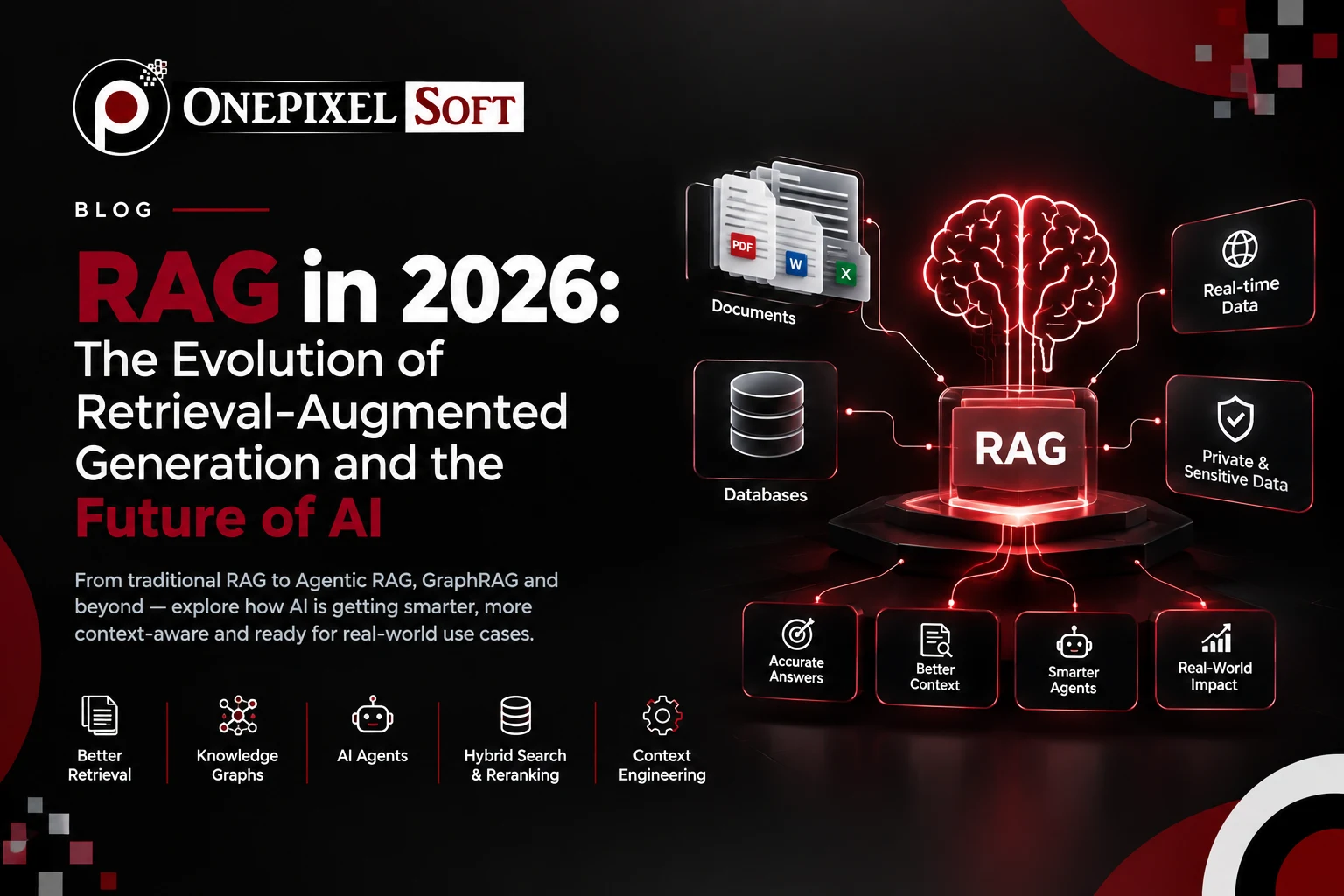
RAG enables AI applications to answer questions using relevant documents, enterprise knowledge bases, databases, and other connected data sources. Instead of relying exclusively on information learned during training, a RAG-enabled system can retrieve supporting evidence when a user submits a query.
However, as organizations build increasingly sophisticated AI applications, traditional retrieval pipelines are revealing important limitations. Retrieving a few semantically similar text passages is not always enough to answer complex questions, preserve document context, or deliver reliable results in production.
This has led to the development of more advanced approaches, including hybrid retrieval, contextual retrieval, reranking, GraphRAG, Agentic RAG, and tool-based data access.
The key shift in 2026 is not the disappearance of RAG. It is the evolution of retrieval into a more intelligent, context-aware, and task-oriented component of AI infrastructure.
1. What Is Retrieval-Augmented Generation (RAG)?
Retrieval-Augmented Generation is an AI architecture that combines information retrieval with language generation. It enables an LLM to use relevant external information while responding to a user's question.
A typical RAG system consists of three core components:
- Knowledge source: Documents, databases, internal knowledge bases, or other information repositories.
- Retrieval system: The component that searches for and selects relevant information.
- Language model: The model that uses the retrieved context to generate a response.
A conventional RAG workflow follows these steps:
- Data is collected from relevant sources.
- Documents are parsed, cleaned, and divided into manageable sections.
- The sections are indexed using embeddings, keyword search, or other retrieval methods.
- A user submits a question.
- The system retrieves relevant information from the indexed sources.
- The retrieved evidence is supplied to the LLM.
- The model generates an answer based on the question and available context.
The quality of the final response depends on more than the language model. Data quality, retrieval relevance, context selection, permissions, and answer validation all play important roles.
RAG is particularly useful when an application needs access to specialized, frequently updated, or organization-specific information.
2. What Types of Data Can RAG Handle?
RAG can work with multiple categories of information, depending on the ingestion pipeline, connected tools, and retrieval architecture.
Unstructured Data
Unstructured information is one of the most common sources for RAG applications. It includes:
- PDF reports and technical manuals
- Company policies and employee handbooks
- Legal documents and contracts
- Research papers and knowledge articles
- Emails and customer support documentation
Document-processing pipelines can extract text, metadata, tables, and other relevant content before indexing it for retrieval.
For complex documents, preserving headings, page references, tables, and relationships between sections can significantly improve the usefulness of retrieved evidence.
Structured Data
Structured data is organized into defined fields and records. Examples include customer databases, financial tables, inventory systems, and business analytics platforms.
Although this information can sometimes be indexed for semantic retrieval, direct queries through SQL, APIs, or other specialized tools may be more appropriate for precise filtering, calculations, and aggregations.
For example, answering “What were total sales in September?” is generally better handled by a validated database query than by retrieving loosely related text passages.
Semi-Structured Data
Semi-structured information includes JSON documents, XML files, application logs, and records containing both text and defined fields.
These sources often require specialized parsing and metadata extraction before they can be used effectively by a RAG pipeline.
Dynamic and Real-Time Information
RAG can connect AI applications to frequently updated information, such as product catalogues, customer support tickets, internal documentation, and operational records.
However, real-time accuracy is not automatic. The system must have an appropriate synchronization, indexing, caching, or live-query strategy to ensure that it retrieves sufficiently current information.
Private and Sensitive Enterprise Data
Organizations can use RAG to make internal knowledge available to authorized AI applications without incorporating every document into a model's training process.
Security must still be enforced through authentication, access controls, permission-aware retrieval, encryption, and appropriate data-handling policies. A RAG architecture does not inherently guarantee privacy, confidentiality, or regulatory compliance.
3. Why Is Traditional RAG Considered Outdated?
The statement “RAG is dead” is often used to criticize naive RAG implementations rather than retrieval-augmented generation as a whole.
Traditional RAG commonly relies on fixed-size chunking, vector embeddings, similarity search, and a single retrieval step. This approach remains useful for straightforward questions, but it can struggle when the task requires deeper reasoning or information from multiple sources.
Problem 1: Loss of Context During Chunking
Large documents are often divided into smaller chunks to make indexing and retrieval more efficient. However, splitting a document can separate a statement from the context required to interpret it correctly.
Consider a financial report containing the statement:
“Revenue increased by 12%.”
Without the surrounding context, the retrieved passage may not identify the company, reporting period, comparison baseline, or business unit.
This is a retrieval problem as much as a generation problem. Even a capable LLM cannot reliably recover information that was never retrieved or supplied.
Problem 2: Semantic Search Alone Is Not Enough
Vector search retrieves content based on semantic similarity. It can work well for natural-language questions, but may miss exact identifiers, product codes, contract numbers, technical terms, or precise keyword matches.
For example, a query for a particular contract clause may require an exact legal phrase that a purely semantic search system does not rank highly.
This is why many advanced retrieval pipelines combine vector search with keyword-based retrieval.
Problem 3: Difficulty With Multi-Document Analysis
Questions involving thousands of documents often require more than retrieving a few relevant chunks.
For example:
“Identify recurring risk themes across 5,000 contracts and explain how those risks differ by department.”
Answering this well may require document-level retrieval, entity identification, aggregation, comparison, and evidence verification.
A basic top-k retrieval pipeline may return a small subset of passages and miss important patterns across the wider dataset.
Problem 4: Irrelevant or Redundant Retrieved Content
Retrieval systems may return passages that are related to a query but do not actually answer it. They may also retrieve overlapping or repetitive content that consumes the available context window.
This can distract the model, increase processing costs, and reduce answer quality.
Problem 5: Larger Context Windows Do Not Solve Everything
Modern LLMs can process substantially larger contexts than earlier models. This makes it possible to analyze more information within a single request.
However, a large context window does not eliminate retrieval challenges. Loading entire repositories into every prompt may be expensive, slow, or impractical, and a model may not use every part of a long context equally well.
RAG therefore remains valuable for selective retrieval, scalable knowledge access, data governance, and cost management.
The conclusion: Basic RAG is still useful, but production-grade systems often need better retrieval, stronger context management, and more reliable evaluation.
4. Advanced RAG Technologies Shaping AI in 2026
Modern RAG architectures combine multiple techniques rather than relying on a single retrieval method. The right combination depends on the complexity of the application, the type of data, and the required level of accuracy.
4.1 Hybrid Search
Hybrid search combines different retrieval methods, commonly dense vector search and sparse keyword search.
Vector search identifies semantically related content, while keyword search can identify exact terms, identifiers, and phrases.
The results can be combined through a ranking strategy, such as Reciprocal Rank Fusion (RRF), and then passed to a reranking stage.
Why it matters: Hybrid retrieval can improve coverage when a query contains both conceptual language and exact terms. It is particularly useful for technical documentation, enterprise search, and legal or financial documents.
4.2 Contextual Retrieval
Contextual retrieval addresses a fundamental weakness of conventional chunking: an isolated passage may not contain enough information to explain what it means.
This technique enriches each chunk with relevant document-level or section-level context before indexing. Contextual information can then support both embedding-based and keyword-based retrieval.
For example, instead of indexing only “Revenue increased by 12%,” the indexed representation may identify the company, reporting year, and financial-report section.
Why it matters: Contextual retrieval can improve the relevance of retrieved passages and reduce ambiguity. Its performance benefits depend on the quality of contextual descriptions and the evaluation dataset.
4.3 Reranking
Reranking introduces a second-stage relevance assessment after the initial retrieval step.
A typical pipeline works as follows:
- Retrieve a broader set of candidate passages.
- Evaluate each candidate against the user's query using a reranking model.
- Select the most relevant passages.
- Supply those passages to the LLM.
The initial retrieval stage prioritizes speed and coverage, while reranking focuses on relevance.
Why it matters: Reranking can reduce the number of irrelevant passages reaching the LLM and improve the quality of the final context. The additional computation must be balanced against latency and cost.
4.4 GraphRAG
GraphRAG combines retrieval-augmented generation with a knowledge graph representing entities and their relationships.
Instead of treating every passage as an isolated text segment, a graph-based system can represent relationships among people, organizations, products, projects, events, and concepts.
A GraphRAG pipeline may extract entities and relationships from documents, construct graph structures, generate summaries of related entities or communities, and use these representations during retrieval.
For example, an enterprise system might need to identify relationships between suppliers, contracts, departments, and recurring operational risks.
Graph-based retrieval can help answer questions that require understanding those connections across many documents.
Why it matters: GraphRAG can be valuable for complex, relationship-oriented questions and broader analysis across a knowledge collection. However, graph construction introduces additional indexing, maintenance, and computational costs. It is not automatically better than conventional RAG for every use case.
4.5 Agentic RAG
Agentic RAG introduces an AI agent that can make decisions about how to retrieve information and complete a task.
Instead of performing one retrieval operation, an agent may:
- Analyze the user's question.
- Break a complex task into smaller questions.
- Select an appropriate search tool or data source.
- Retrieve relevant evidence.
- Evaluate whether the evidence is sufficient.
- Perform additional searches when necessary.
- Generate a response grounded in the collected information.
For example, a research assistant may need to consult internal documentation, compare information across several reports, and verify a conclusion before responding.
Agentic RAG can coordinate these steps dynamically.
Why it matters: It supports multi-step research and complex workflows. However, additional agent steps can increase latency, token consumption, and the risk of errors. Clear tool permissions, execution limits, and evaluation mechanisms remain essential.
4.6 Corrective RAG (CRAG)
Corrective RAG introduces a mechanism for evaluating retrieved evidence and responding when its quality is insufficient.
Depending on the implementation, the system may filter irrelevant results, refine a query, retrieve from an alternative source, or use an authorized web-search tool.
For example, if an internal knowledge base does not contain sufficient information to answer a question, the system may identify the gap rather than immediately generating an unsupported response.
Why it matters: Corrective retrieval can improve resilience when initial search results are weak. It cannot guarantee correctness, particularly when the evaluation mechanism or fallback sources are themselves unreliable.
4.7 Direct Tool Use and Talk-to-Data
Not every task should be solved through document retrieval.
AI applications can use specialized tools to access structured information and execute well-defined operations.
Examples include:
- SQL for querying relational databases
- APIs for retrieving live application data
- Code-search tools for locating functions and symbols
- Data-analysis tools for calculations and aggregation
- Search engines for locating external information
Consider a user asking for the number of orders placed during a specific period. A validated database query can calculate the result directly, while a retrieval system searching descriptive text may return incomplete information.
Why it matters: Direct tool use enables an AI system to select the right execution method for the task. It also makes it easier to validate outputs for calculations and structured queries.
5. RAG vs. Long-Context LLMs: Which Approach Is Better?
Long-context models and RAG solve overlapping but different problems.
A long-context model can process a large amount of supplied information in one request. RAG retrieves a relevant subset of information from a larger external collection.
| Factor | RAG | Long-Context Processing |
| Knowledge access | Retrieves selected external information | Processes information supplied in the context |
| Large repositories | Supports selective access at scale | May require selecting or loading substantial content |
| Changing information | Can retrieve updated sources when properly synchronized | Requires updated information to be supplied |
| Processing cost | Depends on retrieval and generation workload | Depends on the size of the supplied context and model |
| Best fit | Large, evolving knowledge collections | Tasks requiring extensive supplied context |
These approaches are complementary rather than mutually exclusive.
A hybrid architecture can use RAG to find relevant documents, then provide a larger selection of those documents to a long-context model for synthesis and analysis.
The appropriate design depends on retrieval quality, context limits, data sensitivity, response time, and total cost.
6. The Role of Context Engineering in Modern RAG
Context engineering refers to the process of selecting, organizing, and managing the information supplied to an LLM during a task.
It extends beyond retrieval to include the structure and quality of the model's working context.
Important components can include:
- Relevant retrieved passages and source references
- Conversation history and task state
- Structured data returned by tools
- Instructions and output constraints
- Summaries of long documents or earlier steps
- Information about uncertainty and missing evidence
A well-designed system should avoid sending unnecessary information to the model while preserving the evidence needed to answer the question.
For example, a customer-support assistant may combine a retrieved troubleshooting guide, the customer's authorized account information, and the current conversation. The system must distinguish verified account data from general documentation and respect access permissions.
Context engineering is therefore not a replacement for RAG. It is a broader design discipline that helps retrieval, tools, and models work together effectively.
7. How to Choose the Right RAG Architecture
There is no single architecture that works best for every AI application. The correct choice depends on the data, the questions users ask, and the reliability requirements.
| Use Case | Recommended Starting Point |
| Basic document question-answering | Standard RAG with effective chunking |
| Technical or exact-term searches | Hybrid search with keyword and vector retrieval |
| Long documents with missing context | Contextual retrieval and metadata |
| High-precision document search | Retrieval followed by reranking |
| Cross-document relationship analysis | GraphRAG or graph-enhanced retrieval |
| Multi-step research and investigations | Agentic RAG with controlled tool use |
| Structured business calculations | SQL or specialized data tools |
| Unreliable or incomplete search results | Retrieval evaluation and corrective strategies |
These approaches can be combined. For example, an enterprise research assistant might use hybrid search to retrieve candidates, a reranker to improve relevance, a knowledge graph to explore relationships, and an agent to coordinate the workflow.
The most sophisticated architecture is not necessarily the most effective one. Added complexity should be justified by measurable improvements in quality, reliability, or business outcomes.
8. How to Evaluate a Production-Ready RAG System
Building a RAG application requires more than connecting a vector database to an LLM. Its performance should be evaluated across the complete retrieval-and-generation pipeline.
Retrieval Quality
Measure whether the system retrieves the evidence needed to answer a question. Relevant metrics include Recall@k, Precision@k, and ranking measures such as Mean Reciprocal Rank or Normalized Discounted Cumulative Gain.
Answer Quality
Assess whether the generated answer is accurate, complete, relevant, and supported by the retrieved sources.
Grounding and Citation Accuracy
Verify that factual claims are supported by the cited evidence and that source references point to the correct documents or passages.
Latency and Cost
Measure retrieval time, model-processing time, total response latency, and the cost of indexing and answering queries.
Security and Permissions
Test whether users can retrieve only information they are authorized to access. Permission checks must apply to retrieved documents and tool results, not just the final response.
Continuous Evaluation
Use representative questions, expected answers, source documents, and failure cases to compare system changes. Re-evaluate after changing chunking, embeddings, prompts, rerankers, or retrieval strategies.
A system that produces impressive answers in a small demonstration may still fail on ambiguous queries, missing data, permission boundaries, or large-scale workloads.
9. What Is the Future of RAG Beyond 2026?
The evolution of RAG points toward systems that combine several capabilities rather than relying on one retrieval technique.
More adaptive retrieval: Systems will increasingly select between keyword search, vector search, graph traversal, and direct queries according to the task.
Agent-driven workflows: AI agents will coordinate searches, tools, and validation steps for complex tasks, with appropriate limits and human oversight.
Better context management: Contextual retrieval, structured summaries, and task-specific context selection will help reduce irrelevant information.
Multimodal retrieval: RAG systems can extend beyond text to retrieve information from images, diagrams, audio, video, and other supported data formats.
Stronger evaluation and governance: Enterprise deployments will place greater emphasis on evidence quality, access control, observability, reproducibility, and measurable performance.
More efficient architectures: Systems will balance answer quality against model usage, indexing expenses, response time, and infrastructure requirements.
These developments do not make every traditional technique obsolete. Instead, they expand the range of retrieval strategies available to developers.
Conclusion
Retrieval-Augmented Generation remains an important approach for building AI applications that need access to external and organization-specific knowledge. What is changing is the expectation that a single semantic search followed by one LLM response will be sufficient for every task.
Modern AI systems can combine hybrid retrieval, contextual chunking, reranking, knowledge graphs, agentic workflows, and direct tool execution to address different classes of problems.
For businesses, the priority should be selecting an architecture that fits their data and use cases, then validating it with real-world evaluation, security controls, and cost measurements.
The future of RAG is not simply about retrieving more information. It is about retrieving the right evidence, preserving its context, selecting the right tools, and producing answers that can be evaluated and trusted.
Frequently asked questions (FAQs)
Q1. Is RAG dead in 2026?
No. RAG remains useful for connecting LLMs to external knowledge. The main change is the move from simplistic, one-shot retrieval toward advanced architectures that can combine better search, reranking, context management, and tool use.
Q2. What is the difference between traditional RAG and Advanced RAG?
Traditional RAG often uses a straightforward retrieve-and-generate pipeline. Advanced RAG can add hybrid search, contextual retrieval, reranking, query transformation, evidence evaluation, and other techniques to improve retrieval and answer quality.
Q3. What is Agentic RAG?
Agentic RAG uses an AI agent to plan retrieval steps, select tools, evaluate evidence, and perform additional searches when needed. It is useful for complex tasks that require multiple sources or sequential operations.
Q4. What is GraphRAG used for?
GraphRAG combines retrieval with knowledge graphs to represent relationships between entities and concepts. It can help answer questions that require relationship-aware reasoning or analysis across a large document collection.
Q5. What is hybrid search in RAG?
Hybrid search combines retrieval methods such as vector search and keyword search. It helps systems find both semantically related content and passages containing specific terms, identifiers, or phrases.
Q6. What is contextual retrieval?
Contextual retrieval enriches document chunks with relevant background information before indexing. This helps preserve meaning and can improve the ability of a retrieval system to find the correct passages.
Q7. What is reranking in RAG?
Reranking is a second-stage retrieval process that scores initially retrieved candidates for relevance to a query. The highest-ranked passages are then selected as context for the language model.
Q8. Can long-context LLMs replace RAG?
Not universally. Long-context models can process large amounts of supplied information, while RAG enables selective retrieval from larger external collections. Combining both approaches can be useful for complex document-analysis tasks.
Q9. Does RAG prevent AI hallucinations?
No. RAG can help ground responses in external evidence, but incorrect retrieval, unreliable sources, or unsupported model conclusions can still produce errors. Source verification and answer evaluation are important.
Q10. Is GraphRAG better than vector-based RAG?
Neither is universally better. Vector-based RAG is often effective for semantic document search, while GraphRAG can be useful when relationships across entities and documents are important. The best choice depends on the task, data, cost, and performance requirements.
Q11. Can RAG access real-time enterprise data?
Yes, when connected to suitable data sources and supported by appropriate synchronization or live-query mechanisms. Freshness depends on the implementation and how quickly source updates become available.
Q12. How can businesses improve RAG accuracy?
Businesses can improve RAG by cleaning source data, preserving document structure, using appropriate chunking, combining keyword and vector search, adding reranking where beneficial, validating answers against evidence, and evaluating the system with representative real-world questions.